
'Expect India to keep doing well irrespective of geopolitics.'

With the first quarter earnings season coming to an end, the domestic equity markets would be driven by global trends and trading activity of foreign investors this week, analysts said. The movement of global oil benchmark Brent crude and the rupee against the dollar would also drive trends in the market. "Macroeconomic indicators, trends in global stock markets and FII activities will be pivotal in shaping market trends in the coming days," Pravesh Gour, senior technical analyst at Swastika Investmart Ltd, said.

Ask rediffGURU and PF expert Nitin Narkhede your mutual fund and personal finance-related questions.

March 31 marked 10 years since the Modi government introduced its first Foreign Trade Policy (FTP 2015-20) that lasted for 8 years before the current FTP 2023 came in. Here is a brief assessment. In 2015, the government said that it aims to increase India's exports of merchandise and services from $465.9 billion in 2013-14 to approximately $900 billion by 2019-20 and to raise India's share in world exports from 2 per cent to 3.5 per cent.

The share of foreign investors was lower than domestic institutions across key sectors, including commodities, consumer discretionary, financial services and industrials.

From the 30-share Sensex pack, Tata Consultancy Services and Infosys jumped over 4 per cent each. HCL Technologies, Tech Mahindra, Adani Ports, Larsen & Toubro, Maruti and Reliance Industries were also among big gainers. Titan, IndusInd Bank, Hindustan Unilever, Axis Bank and HDFC Bank were the laggards.

'If I have to go back, I would rather go back now because I don't want to face that situation when I'm in my 40s.' A young couple's journey through immigration uncertainty reveals not just the human cost of policy announcements, but a surprising rekindling of love for the homeland left behind.

India's financial sector is dominated by large government-owned and private-sector banks.

From the 30 Sensex firms, Mahindra & Mahindra, Infosys, Kotak Mahindra Bank, JSW Steel, Adani Ports, Tata Motors, Adani Ports, ITC and Titan were the major laggards. HDFC Bank, Bharti Airtel, Reliance Industries, Asian Paints and State Bank of India were the gainers.

From the 30 Sensex firms, Bajaj Finance, Reliance Industries, Tata Steel, JSW Steel, Tech Mahindra, Tata Motors, Kotak Mahindra Bank and Maruti were the biggest laggards. Reliance Industries Ltd, India's most valuable company, on Monday reported a 5 per cent fall in the July-September quarter net profit as weak oil refining and petrochemical business hurt operational performance. ICICI Bank, Bharti Airtel, Asian Paints, Adani Ports, UltraTech Cement and HCL Technologies were among the gainers.

The number of persons employed in 27 sectors, including agriculture, trade and financial services, increased by 3.31 per cent year-on-year to 59.66 crore in 2022-23, according to data published by the RBI on Monday. During 2021-22, the employment in these 27 sectors stood at 57.75 crore.

In an eventful week ahead, stock markets may face volatile trends before the RBI's interest rate decision and the US inflation data announcements, as investors continue to assess the broader implications of US tariffs on global economy and inflation, analysts said. Investors fear that a full-blown trade war will impact global trade and economic growth, according to market experts.

This will be the first full-year Budget of the BJP-led National Democratic Alliance government since it came to power for a third consecutive term in July last year.

From the 30-share Sensex pack, Tata Consultancy Services, Infosys, NTPC, HCL Technologies, Axis Bank, Tech Mahindra, Bajaj Finserv, Sun Pharma, IndusInd Bank and Reliance Industries were the major laggards. Tata Steel, Hindustan Unilever, Mahindra & Mahindra, Nestle and State Bank of India were among the gainers.

IT industry's growth will largely be led by next-generation technologies and services with areas like data, cloud and cybersecurity expected to see huge incremental growth, Wipro CEO Theirry Delaporte said. Wipro has also closed several acquisitions in the second half of FY21 across key markets like the US and Europe, which has helped the Bengaluru-based company strengthen its local presence and service offerings, he said in his note in the company's FY2020-21 annual report. "We know that industry growth will largely be led by next-generation technologies and services. "We can therefore expect to see huge incremental growth in areas such as digital, cloud, data, engineering, cybersecurity.

'Listing of scaled Indian subsidiaries of multinational corporations as well as of Indian conglomerates continues to remain a key theme for IPOs in India.'

But the industry's chief executives remain confident of the long-term growth potential of NBFCs in India, given their specialised lending on the asset side, last-mile reach, and a well-capitalised balance sheet. "Over the years, NBFCs have faced many crises.

For financial sector companies setting up shop in India, as of now the go-to regulators are obviously Sebi and the RBI with carve-outs for IRDAI or possibly PFRDA. But this could change soon with the International Financial Services Centres Authority, observes Subhomoy Bhattacharjee.

'Subject to any worldwide economic collapse.'

Tasting success with the relaunch of Sensex derivatives in the onshore market, BSE is preparing for the 'offshore' debut of its 30-share index, which has become synonymous with the domestic markets. Sources in the know said that the India International Exchange (India INX), a subsidiary of BSE, received approval in July from the International Financial Services Centres Authority (IFSCA) to launch Sensex 30 derivatives contracts.
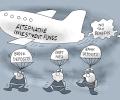
Alternative investment funds (AIFs) - investment vehicles favoured by the affluent - have topped $50 billion (Rs 4.3 trillion) in total investments for the first time during the April-June quarter, according to the latest data from the Securities and Exchange Board of India. The industry's commitments have approached Rs 12 trillion ($140 billion), marking a 40 per cent increase over the past year. The amount raised and deployed stood at Rs 4.74 trillion ($56 billion) and Rs 4.32 trillion ($51 billion), respectively, the data shows.

A leave vote means the future of Britain's financial services industry is now hanging in the balance.

From the 30-share pack, Hindustan Unilever, Tata Motors, Axis Bank, Nestle India, Asian Paints, ITC, Reliance Industries, Mahindra & Mahindra, IndusInd Bank and State Bank of India were among the laggards. Larsen & Toubro, Tata Steel, JSW Steel, HDFC Bank, Adani Ports, Kotak Mahindra Bank, Bharti Airtel and PowerGrid were among the gainers.

The Indian IT industry will stage a "strong recovery" in 2021-22 with a revenue growth of up to 11 per cent, ratings agency Crisil said on Wednesday. The recovery will be led by increasing outsourcing and accelerating digital transformation services mainly in sectors such as banking, financial services and insurance (BFSI), healthcare, retail and manufacturing, it said. As per Nasscom, the IT services industry grew 2.7 per cent to $99 billion in 2020-21.

JM Financial on Wednesday said it had a "careful and detailed review" of the Reserve Bank's order imposing restrictions on the company's financing business and asserted that there was "no material deficiencies" in its loan sanctioning process. The Reserve Bank on Tuesday imposed restrictions on JM Financial Products Ltd after it found the company indulged in various manipulations, including repeatedly helping a group of its customers to bid for various IPOs (initial public offerings) by using loaned funds. "After careful and detailed review of the order issued by the RBI on the action against JM Financial Products Ltd, we strongly believe that there have been no material deficiencies in our loan sanctioning process.

Ritika Gupta, a study abroad expert and founder of Aaera Consultants, explains how Germany's new visa rules will affect international students and working professionals.

From the Sensex pack, Bharti Airtel, HDFC Bank, Titan, UltraTech Cement, ITC, Sun Pharma, Bajaj Finserv, Bajaj Finance, Hindustan Unilever and Kotak Mahindra Bank were among the major gainers. Tata Steel, Axis Bank, NTPC, ICICI Bank and IndusInd Bank were the major laggards.

AIS Technolabs' Global Scholarship Program 2025 offers financial support and leadership opportunities to undergraduate and postgraduate students from around the world, in any field of study.

From the 30-share Sensex pack, Mahindra & Mahindra, Larsen & Toubro, State Bank of India, Reliance Industries, ICICI Bank and Bajaj Finance were the biggest gainers. JSW Steel and Infosys were the laggards.

Finance, ICICI Bank, Mahindra &h Mahindra, Kotak Mahindra Bank and Titan were among the gainers. Bharti Airtel, Adani Ports, Tech Mahindra, Reliance Industries, Axis Bank, Larsen & Toubro were the laggards.

Equity markets will take cues from global trends and trading activity of foreign investors, while in the latter part of the week the first quarter earnings from IT majors TCS and HCL Technologies would guide investor sentiments, analysts said. Markets may consolidate after the record rally last week, experts added. "On the domestic front, the Q1 earnings season begins this week. Key companies such as TCS and HCL Technologies will release their earnings on July 11 and 12, 2024, respectively.

Ask rediffGURU and PF and MF expert Janak Patel your mutual fund and personal finance-related questions.

Reliance Industries (RIL), India's largest conglomerate, is set to pivot into a deeptech and advanced manufacturing enterprise, chairman and managing director (CMD) Mukesh Ambani said. "In artificial intelligence, our purpose is clear: to address complex societal challenges and create wealth for the nation and its people.

In a double-dose bid to boost growth and employment prospects, the Union Cabinet on Tuesday approved a Rs 2.07 trillion outlay for a research development and innovation (RDI) Scheme to fund private sector innovations, and an employment-linked incentive (ELI) to create over 35 million new jobs over the next two years.

In 2024, the National Payments Corporation of India (NPCI) approved 20 third-party Unified Payments Interface (UPI) applications, a record since UPI's launch in 2016. This surge reflects growing interest from financial technology (fintech) companies, driven by the integration of credit products like UPI-linked credit cards and pre-approved credit lines.

Adani Group's portfolio companies posted their highest-ever pre-tax profit (EBITDA) of about Rs 90,000 crore in the fiscal year ended March 31 and had a cash balance to cover 21 months of debt servicing, the ports-to-energy conglomerate said on Thursday. The Earnings Before Interest, Taxes, Depreciation, and Amortisation (EBITDA) has more than tripled in six years - from Rs 24,870 crore in 2018-19 to Rs 89,806 crore in 2024-25 (April 2024 to March 2025).
There remains a debate on who said this: "When the facts change, I change my mind. What do you do, Sir?" Was it the British economist John Maynard Keynes or the American economist Paul Samuelson. Irrespective of who said it, this sentiment appears to have found resonance in ITC's boardroom in recent years.

The ongoing fourth quarter earnings season, global factors and macroeconomic data would guide the trends in the equity markets this week, analysts said. Markets would also take cues from trading activity of foreign investors, rupee-dollar trend and movement of global oil benchmark Brent crude. "Domestically, the next batch of Q4 earnings reports will drive stock-specific movements, Hero MotoCorp, Larsen & Toubro, BPCL, State Bank of India, Eicher Motors and Tata Motors are some of the big names in the list and the next phase of voting," said Pravesh Gour, senior technical analyst, Swastika Investmart Ltd.

Shareholders of industry giants Adani Enterprises, Reliance Industries, and Tata Motors - the latter two are part of the Sensex - will decide on combined related-party transactions of more than Rs 2.68 trillion proposed for this financial year and later. Related-party transactions for BSE 500 companies touched at least a six-year high of Rs 42.1 trillion in FY23, the Capitaline data shows. The Rs 42.1 trillion includes related-party transactions both at balance-sheet and profit-and-loss levels.

The revenue growth of Indian companies for the July-September quarter is estimated to be 5-7 per cent year-on-year (Y-o-Y), marking the slowest growth in 16 quarters, rating agency CRISIL said on Thursday.
